
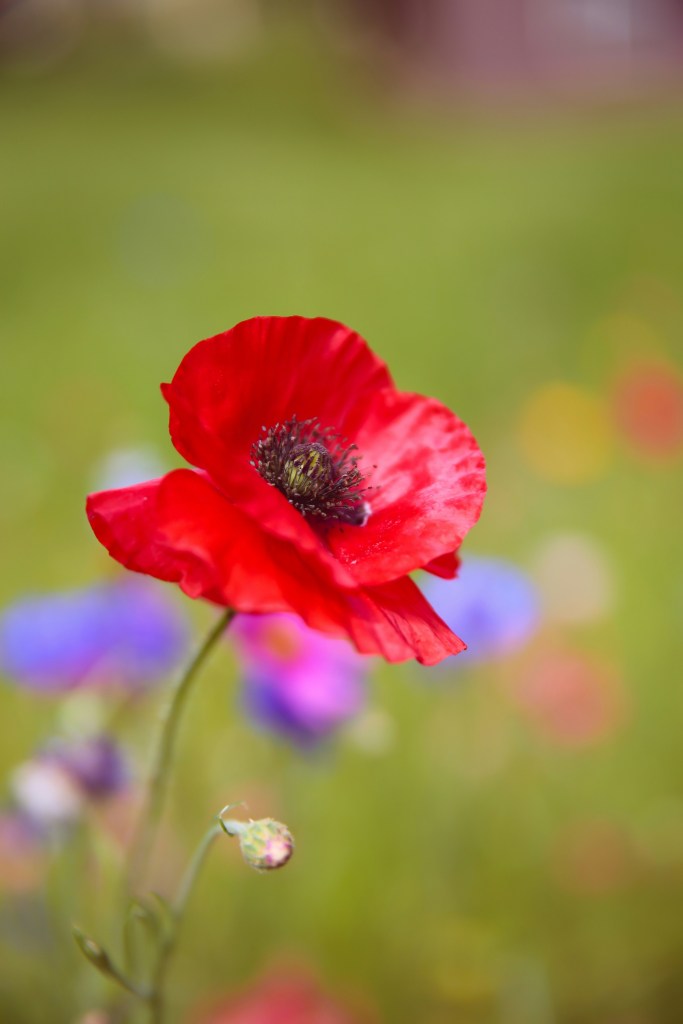
“In Flanders Fields the poppies blow
Between the crosses, row on row,
That mark our place; and in the sky
The larks, still bravely singing, fly
Scarce heard amid the guns below.
We are the dead. Short days ago
We lived, felt dawn, saw sunset glow,
Loved and were loved, and now we lie
In Flanders Fields.”
(John McCrae)
As time moves on and these events move further and further back in history, it’s so important that we always remember the sacrifices of those who served our country, and that we keep their memories alive for the younger generations.
This past summer, I began reading my Grandma’s life story and was quite taken by her wartime accounts. I would like to share with you a little bit about her life and about the love that she lost. I’m sure many of you have similar stories in your family histories. Please join me on this journey back in time.
Viva Cubitt was born March 1, 1921 in Calgary, Alberta to English parents. The family moved back to Bexhill-on-sea, England 11 months later, in part because Viva’s mother was so homesick. They returned to Canada in 1928, settling in Chauvin, Alberta. In 1931, Viva and her family moved to a house on 130 Street and 117 Avenue in Edmonton, and later to a bungalow at the corner of 118 Avenue and Groat Road.
Viva attended Westmount School where she met her best friend, Dolly. As teenagers, Viva and Dolly loved to go skating in the winter at “all the rinks Edmonton had to offer”. Grandma didn’t recall it ever being too cold to skate and said they went every evening after they finished their homework. There were bands playing at the rinks, and boys would ask girls for “a band”, which meant they were asking the girls to skate with them for a song.
On one such outing, a handsome young man named Earle Pritchard asked Viva for “the next band”. My Grandma said this was the beginning of a romance that lasted her entire life. Viva was just 14 when they met, Earle was 18. She later found out that when Earle saw her skating with another fellow, he turned to his friends and said he was going to marry “that girl in the green jacket” one day, and (spoiler alert) he did!
After three years of dating, Earle gave Viva a diamond ring from Birks for Christmas. Her parents felt that 17 was too young, and Earle agreed to exchange the ring for something else. The next day, my Grandma carefully wrapped the ring in Kleenex, put it in her purse and set off to meet Earle and his friend Denny. Her journey took her through a field toward 118 Avenue to catch the streetcar that came down 127 Street. While crossing the snowy field, Viva came across her brother’s lost earmuffs. She picked them up, wrapped them in Kleenex and continued on her journey. When she arrived at a coffee shop to meet Earle and his friend, the ring was gone. She guessed it had fallen out when she wrapped the earmuffs and was now somewhere in the field.
After an agonizing wati for what seemed like an eternity, the three of them boarded the busy Calder streetcar. During the ride, Viva said she was praying they would find the ring, in part because she knew how little Earle made in wages and how long he must have saved up for the ring. She said Earle “loved me so much but still respected my parents enough not to argue for his own desires.”
This story has always enchanted me, so I’ll let my Grandma tell the rest, just as she told it to me many times. “We got off and started walking down 118 Avenue. It was a bright sunny winter day and we approached the path. Earle and Denny were already on the path heading across the field, when I looked down and something blinded me. There on a small raised mound of snow, undisturbed by wagon tracks, horse hoof tracks, car tracks and human foot prints lay the ring, just sparkling so brightly in the sunshine.”
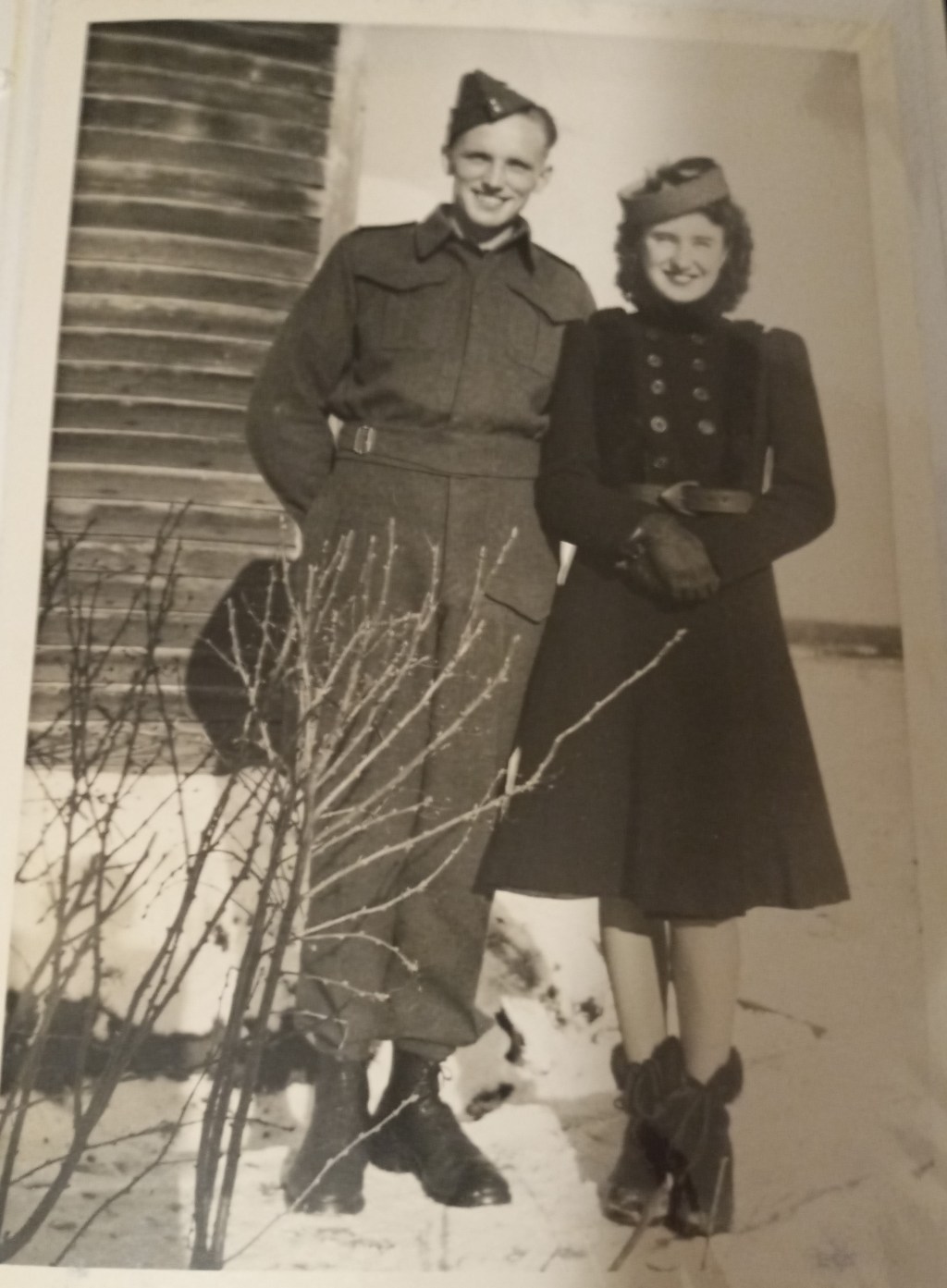
The ring was exchanged for another and Viva and Earle continued going steady. When the Second World War broke out, Earle joined the reserves and later, the regular army. Earle was sent to train as an officer in Gordon Head, BC for six months, then went to Currie Barracks in Calgary.
Earle received word that his regiment, the 49th Loyal Edmonton, would be shipping out overseas, and he and Viva were married while he was on a weekend pass. The marriage took place July 6, 1942 and they had two short days together before his departure. There was no time for a wedding cake, but Viva’s mom (who was an accomplished baker) made one for them after Earle left. My Grandma took a picture of the cake with her brother Guy standing behind it “so it wouldn’t look quite so lonely” (see below) and sent the picture to Earle. She said that she did not want her picture taken with the cake without Earle standing beside her.
In my Grandma’s own words, she said “I don’t think there is ever a loneliness than that felt by two young people in love, separated by war, without knowing what lay ahead”.
In one of his letters, Earle told Viva that he had voluntarily transferred from the Edmonton Regiment to the Royal Canadian Artillery and that fighting was fierce in the area. The Royal Canadian Artillery sadly lost a great many of its officers.
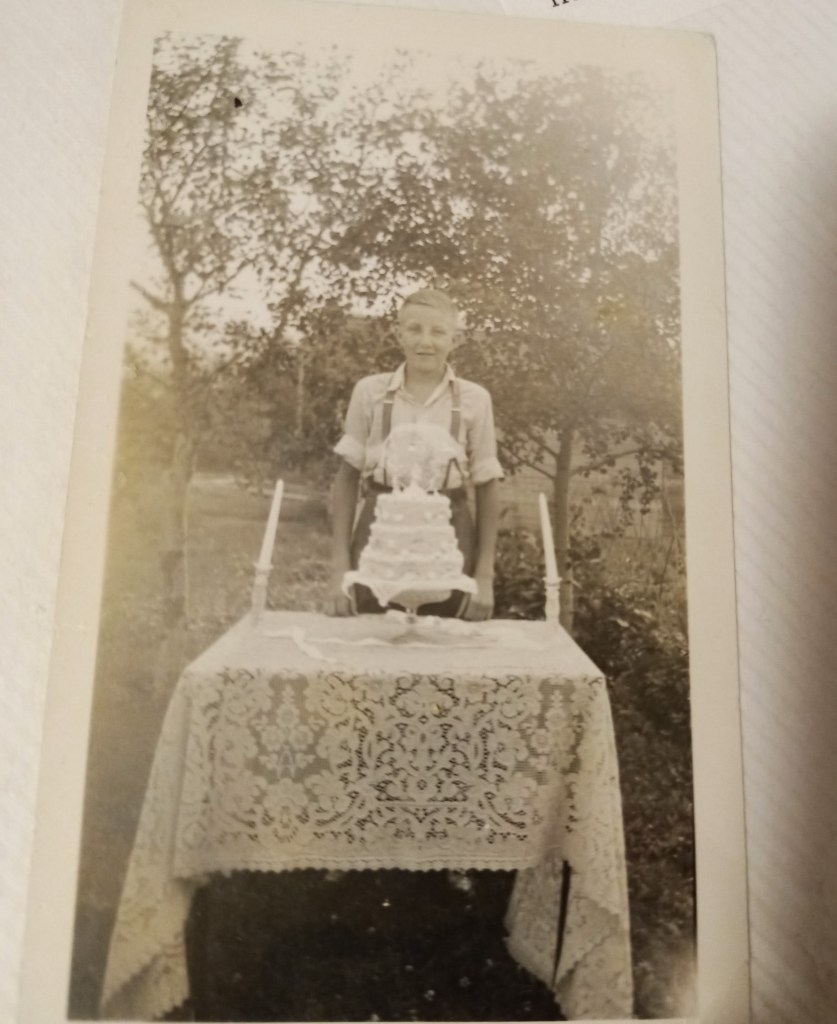
In mid-September, 1944 my Grandma received word that Earle was killed in combat in Italy on September 2. The picture of her brother Guy with the wedding cake was returned to her, along with Earle’s personal effects.
Earle was the love of her life, and while she remarried two more times, I think Earle’s loss left a big hole in her heart that was never fully repaired. She said “There are no words to describe how those of us who received those telegrams felt. Such a dreadful waste!!”
Earle and Viva’s story has always touched me. Whenever I asked my Grandma about Earle, I could feel the deep love she still had for him, as well as the sadness she still felt from losing him. My Grandma said her love for Earle was everlasting, and she believed he was looking after her after his passing. Over the yeras, she shared some incredible stories with me that would lead me to believe she was right.
While we obviously never met Earle and are not biologically related to him, it is not lost on my Mom, her sister, my two brothers, our two cousins and me that had Earle survived the war, none of us would be here. My Grandma lost the love of her life, but she gained a loving, cherished family that, at the time of her passing, included two daughters, five grandkids and a whole lot of great grandchildren (or “greats”, as she fondly called them). Earle made the ultimate sacrifice for his country, as did so many other young Canadians. I am grateful to him for his sacrifice and for the love he gave my Grandma.
While I have always known about Earle from stories my Grandma told me, reading her personal account has now given me some insight into the immense difficulties and heartache faced by so many young couples and families during the war. It’s something that only those who experienced it first hand can truly understand, and something that the rest of us should never forget.
In Remembrance
 kpoweryoga | in person, on-demand and livestream yoga | Edmonton, AB, Canada
Leave a comment